Create weekly visibility
Combined cash, funding, receivables, purchase orders, certified invoices and expected project payments.
Case study 03 · Liquidity planning
How a rolling weekly model can connect committed spend, expected claims and approved funding to expose a short-lived liquidity trough before it becomes an operational issue.
A capital programme managed multiple sites, purchase orders, contractor claims and funding approvals. The annual budget did not provide enough visibility over near-term liquidity or payment timing.
Committed spend, expected certificates and approved funding sat in separate systems, creating uncertainty over weekly cash needs and increasing the risk of avoidable payment delays.
Combined cash, funding, receivables, purchase orders, certified invoices and expected project payments.
Applied probability and timing assumptions to unbilled commitments and contractor claims.
Tested base, delayed-funding and accelerated-project scenarios across a rolling 13-week horizon.
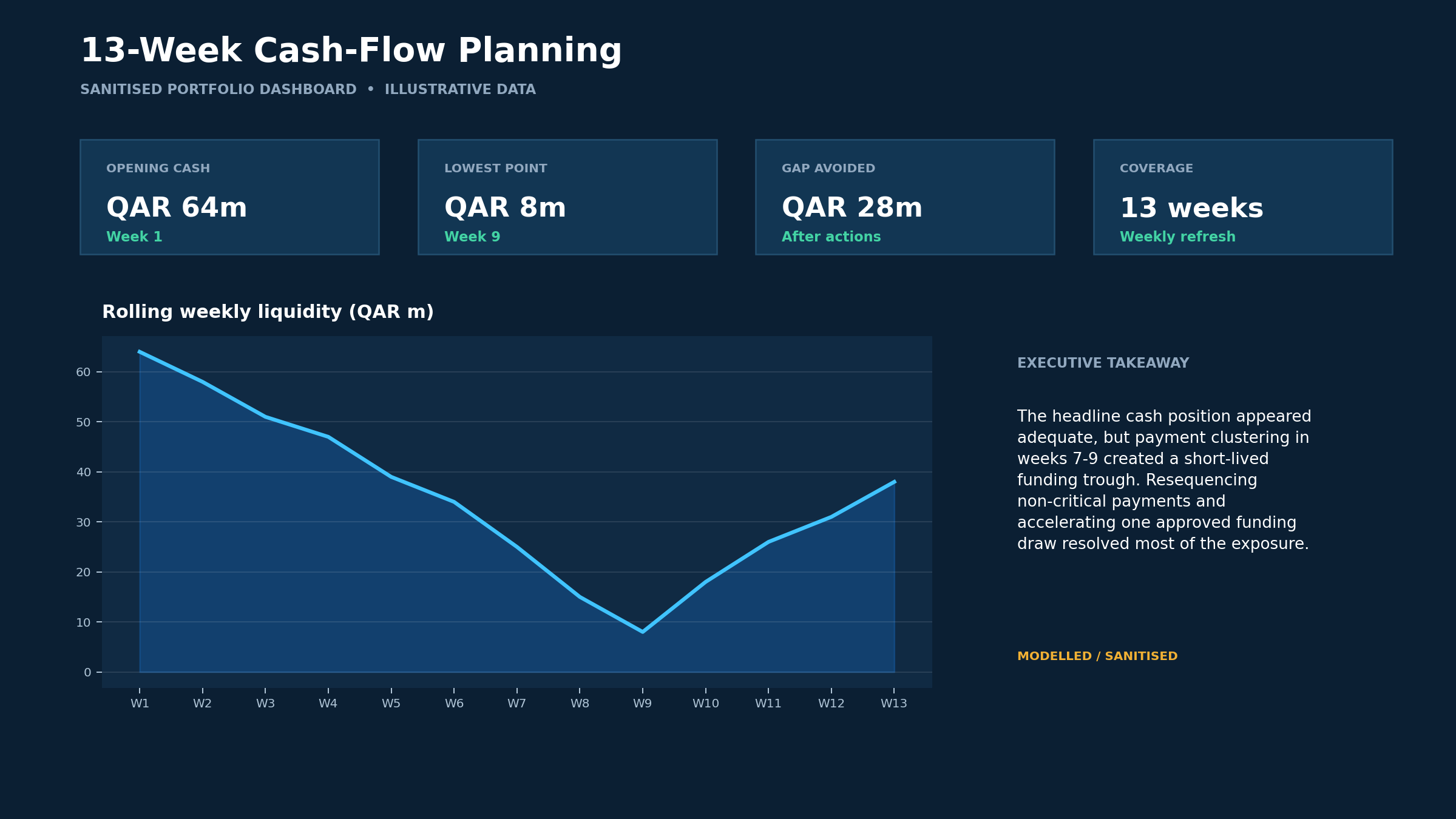
Illustrative dashboard using fictional names and modelled values.
The headline cash position appeared adequate, but payment clustering in weeks 7–9 created a temporary funding trough. Resequencing non-critical payments and accelerating one approved funding draw resolved most of the exposure.
Adopt a weekly cash committee, clear ownership for every inflow and outflow, confidence-weighted scenarios and trigger points for funding escalation or payment resequencing.
Reduction in the peak funding gap from QAR 36m to QAR 8m, while protecting critical suppliers and avoiding disruption to priority projects.