Expose bias
Assessed forecast accuracy and bias by entity, line item and forecast horizon.
Case study 02 · Driver-based planning
How a common driver library, controlled assumptions and exception-based review can reduce version debate and redirect management attention toward decisions.
Business units prepared forecasts using inconsistent assumptions, formats and submission calendars. Senior management received limited explanation of movements after consolidation.
Manual consolidation slowed the cycle, forecast bias was difficult to challenge and operational drivers were not consistently linked to the P&L, balance sheet and cash flow.
Assessed forecast accuracy and bias by entity, line item and forecast horizon.
Linked occupancy, ADR, units, fee rates, headcount, milestones and working capital to financial outcomes.
Introduced controlled scenarios and bridges from the prior forecast to focus discussion on material changes.
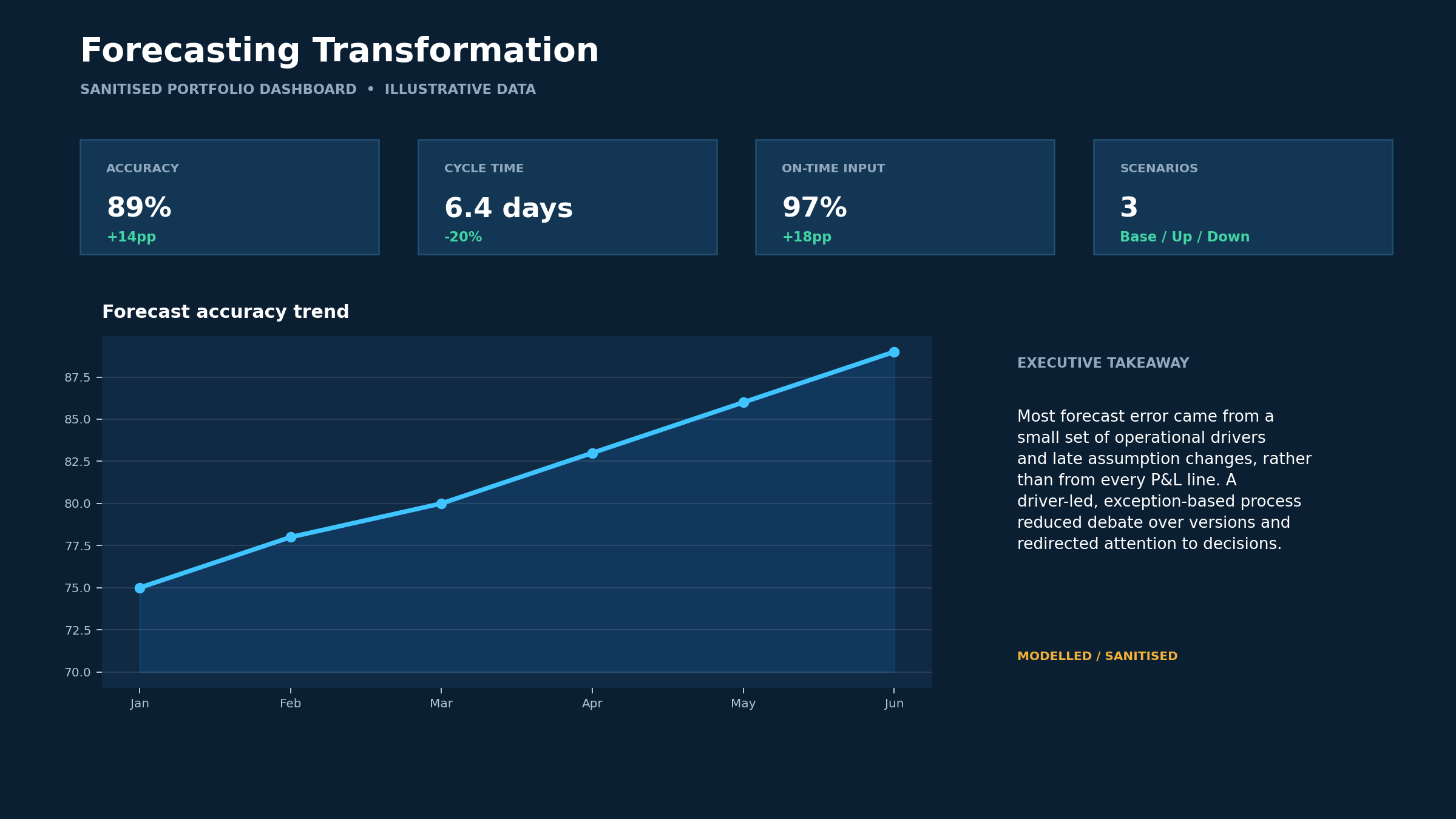
Illustrative dashboard using fictional names and modelled values.
Most forecast error came from a small set of operational drivers and late assumption changes, rather than every P&L line. A driver-led, exception-based process reduced debate over versions and redirected attention to decisions.
Implement one forecast calendar, controlled assumptions, entity sign-off and monthly accuracy tracking. Require owners to explain material movements against the previous forecast.
A 14 percentage-point improvement in forecast accuracy and a 20% faster reporting cycle, with clearer accountability for risks and opportunities.